Multi-Agent Sales Prospecting: Four Connected AI Agents
Four connected AI agents handle sales prospecting from targeting to personalized outreach. Maintain context across research, qualification, and messaging steps.
Sales prospecting fails at the handoffs—not the capabilities. You build lists in one tool, research in another, qualify somewhere else, then stare at blank templates for outreach.
Context disappears between steps. Criteria drift across tools. Momentum dies in the transitions.
Four Agents, One Connected Workflow
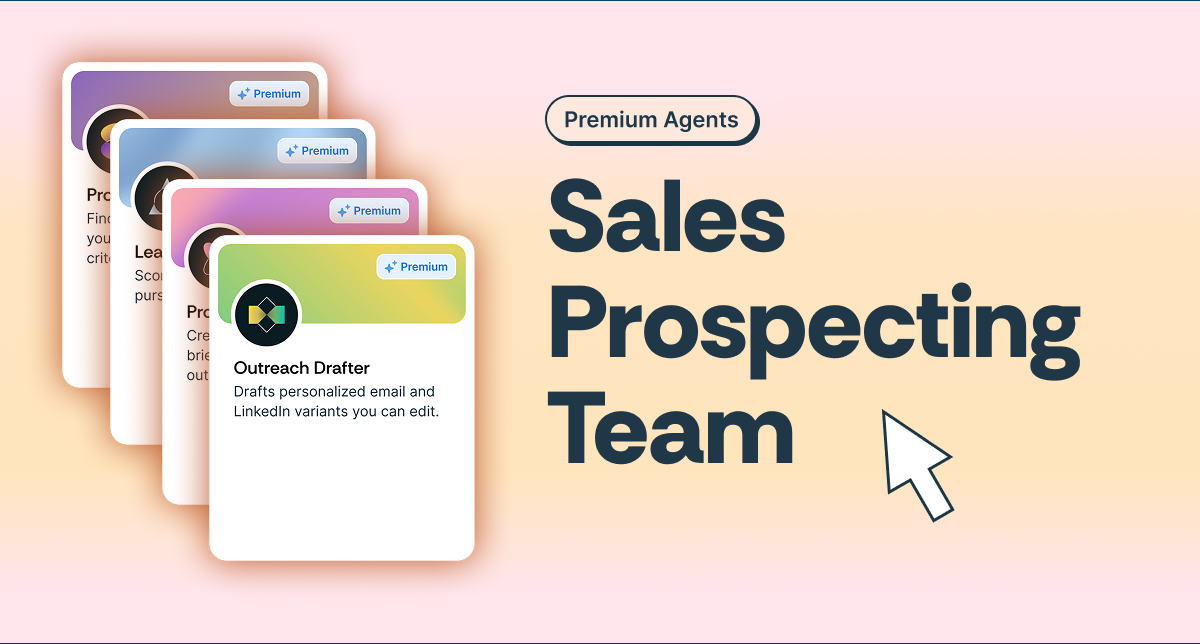
The Sales Prospecting Team bundles four AI agents into a connected workflow that maintains context across every step:
- Prospect Finder — interprets plain-language targeting criteria and generates ranked prospect lists
- Prospect Research — converts names into structured intelligence briefs with outreach angles
- Lead Qualifier — scores ICP fit and recommends pursue/nurture/pass decisions
- Outreach Drafter — generates personalized email and LinkedIn message variants
Each agent passes context forward instead of starting fresh. Your targeting criteria, research findings, and qualification decisions inform every downstream step.
End-to-End Prospecting Workflow
Step 1: Natural Language Targeting
Describe your ideal prospects in plain language—role, industry, company size, geography, buying signals. Prospect Finder interprets your criteria and shows its understanding before execution.
No Boolean search syntax or field mapping required. The agent generates ranked shortlists based on your natural language description.
Step 2: Structured Intelligence Gathering
Prospect Research converts each prospect into an actionable intelligence snapshot:
- Role responsibilities and decision-making authority
- Likely business priorities and pain points
- Recommended outreach angles and messaging themes
- Communication style indicators from public content
The output isn't raw data dumps—it's structured intelligence designed for sales action.
Step 3: Consistent Qualification
Lead Qualifier applies your ICP criteria consistently across prospects. It generates 0-100 fit scores, assesses timing indicators, and recommends next actions.
Each recommendation includes transparent reasoning and criteria breakdown. You can validate or override decisions with full context of how the score was calculated.
Step 4: Context-Aware Outreach
Outreach Drafter generates ready-to-send message packages:
- 2-3 email variants with different angles
- 1-2 LinkedIn message options
- Personalization signals surfaced for review
- Subject line variations for A/B testing
No blank page problem. Every draft incorporates upstream research and qualification context automatically.
Practical Impact on Sales Operations
Connected AI agents eliminate the friction points that slow prospecting velocity. Teams report 5-10 hour weekly savings by reducing manual list building and research duplication.
More importantly, the structured outputs make prospecting coachable and scalable. Fit scores and rationale create consistent qualification standards across team members.
Best Fit Use Cases
This multi-agent approach works particularly well for:
- Sales leaders implementing consistent ICP application across teams
- Founders and operators fitting prospecting around other priorities
- Marketing teams needing thoughtful outreach without extensive manual research
- Client-facing teams requiring personalized messaging at scale
The $25/month pricing makes it accessible for individual contributors and small teams testing autonomous-agents for sales workflows.
Multi-Agent Architecture Advantages
This isn't just workflow automation—it's context preservation across specialized agents. Each agent optimizes for its specific task while maintaining shared context.
Prospect Finder doesn't need to draft messages. Outreach Drafter doesn't need to score leads. But both agents share the same understanding of your ICP and value proposition.
This specialization-with-context approach delivers better outputs than single multipurpose agents or disconnected point solutions.
Why Connected Agents Matter
Most sales tools solve individual steps well but break at integration points. Prospect data doesn't flow cleanly into research tools. Research insights don't inform outreach templates.
AI agents with persistent context solve the handoff problem that kills prospecting momentum. When each step builds on previous decisions, the entire workflow becomes more intelligent and efficient.