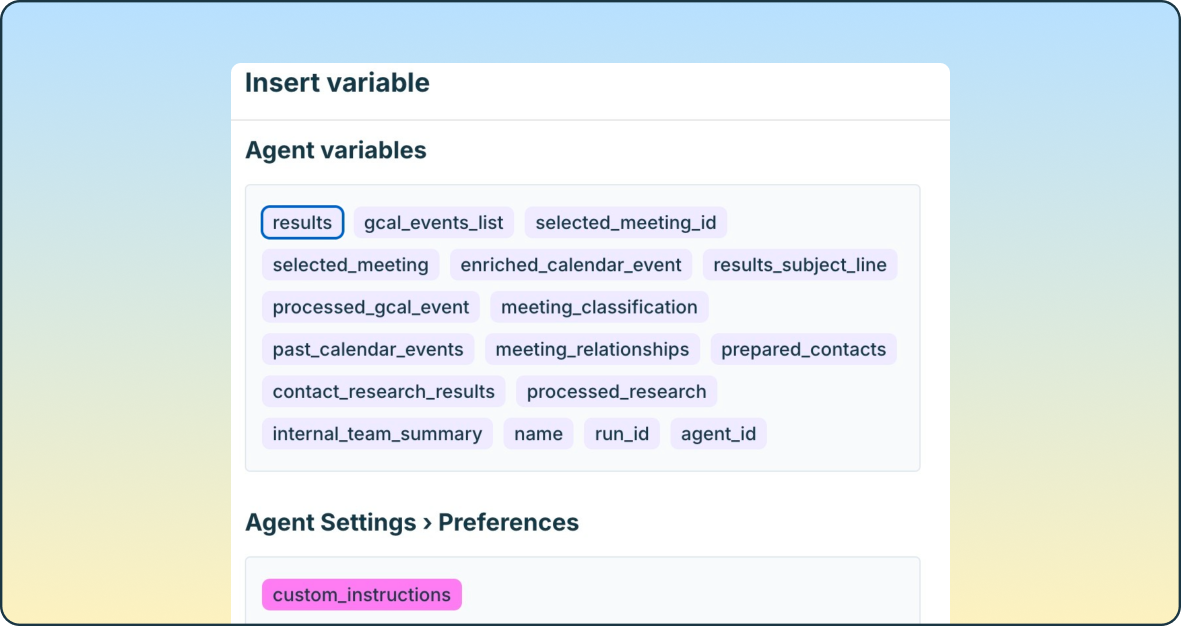
How Custom Instructions Transform AI Agent Performance
Custom Instructions give AI agents persistent memory about your business context and communication style, eliminating repetitive setup and ensuring consistent outputs.
The Context Problem Every AI Agent User Faces
Every AI professional knows the frustration: you've spent time explaining your business context, tone preferences, and specific requirements to an AI agent, only to have to repeat the same information in the next session. This constant re-explanation wastes time and leads to inconsistent outputs that don't match your brand voice or business needs.
Custom Instructions solve this persistent problem by giving AI agents lasting memory about your business context and communication style.
Understanding Custom Instructions for AI Agents
Custom Instructions represent a fundamental shift in how AI agents maintain context. Instead of treating each interaction as isolated, these instructions create persistent memory that carries forward across all agent sessions.
Think of Custom Instructions as a comprehensive briefing document that includes:
- Business profile: Your company, products, and services
- Industry context: Specific market conditions and terminology
- Target audience: Customer demographics and ideal customer profile
- Communication style: Tone preferences, formality level, and messaging approach
- Operational preferences: How you prefer information structured and presented
The Technical Impact on Agent Performance
When properly configured, Custom Instructions influence multiple aspects of agent behavior:
Output Personalization
Agents automatically adjust their communication style to match your preferences. A formal corporate environment receives different language than a casual startup setting, without requiring explicit prompting each time.
Contextual Relevance
Business-specific terminology and industry knowledge become embedded in responses. This eliminates the need to explain your market position or competitive landscape repeatedly.
Consistency Across Sessions
Perhaps most importantly, Custom Instructions ensure that agent outputs maintain consistent quality and voice across different users and time periods within your organization.
Implementation Strategy for Maximum Impact
Setting up effective Custom Instructions requires strategic thinking about what information provides the most value:
Essential Elements to Include
Start with core business information: company mission, primary products or services, and target market. Then layer in communication preferences: preferred tone, typical response length, and level of technical detail appropriate for your audience.
Optimization Over Time
Custom Instructions work best when refined based on actual usage. Monitor agent outputs and adjust instructions when responses don't match your expectations or brand voice.
Measuring the Business Impact
Organizations implementing Custom Instructions typically see:
- Reduced setup time: Elimination of repetitive context-setting in agent prompts
- Improved output quality: More relevant, brand-consistent responses
- Enhanced productivity: Less time spent editing and refining agent outputs
- Better user adoption: Teams more willing to use agents that understand their context
Advanced Applications and Use Cases
Beyond basic personalization, Custom Instructions enable sophisticated workflow automation. Marketing teams can embed brand guidelines directly into content creation agents. Sales teams can ensure CRM updates match their specific data requirements. Customer service agents can maintain consistent tone across all interactions.
The key insight is moving from reactive prompting to proactive agent configuration, creating AI assistants that truly understand your business from the first interaction.